Large local and medium taxpayers
November 1, 2026
They may issue only electronic tax documents. Their paper B sequences expire on October 31, 2026.
Electronic invoicing for businesses · Dominican Republic
Connect your ERP, POS, or custom system to an electronic invoicing layer designed for numbering, signing, DGII, evidence, and recovery
01
The deadline
Large local and medium taxpayers
November 1, 2026
They may issue only electronic tax documents. Their paper B sequences expire on October 31, 2026.
Small, micro, and unclassified taxpayers
November 15, 2026
Date resulting from the six-month general extension granted by DGII on May 6, 2026.
Law 32-23: failing to issue e-CF within the deadline is a tax violation under articles 27 to 29, punishable by fines of 5 to 30 minimum wages
02
Track record
2016
ERP implementations with Odoo for Dominican businesses
2018
Indexa S.R.L. is established and specializes in electronic invoicing
November 2021
DGII authorizes Indexa as an electronic invoicing service provider
2023
Recurring issuance for businesses in several sectors
Today
Timbro, the same team’s product stage
+6Melectronic documents invoiced since 2023
+80businesses certified or issuing with the team
Nearly 5 yearsas a DGII-authorized provider
03
References
04
The right position
01
ERP, POS, or Checkout
02
Idempotent acceptance of every request
03
Sequence validated or assigned within the range
04
Signed with the business certificate
05
Submission, response, and result tracking
06
Printed representation, delivery, and traceability
The ERP keeps the customer master, prices, and business accounting
Timbro does not replace the sales system: it runs the fiscal cycle and returns a status the ERP records once
05
Integration
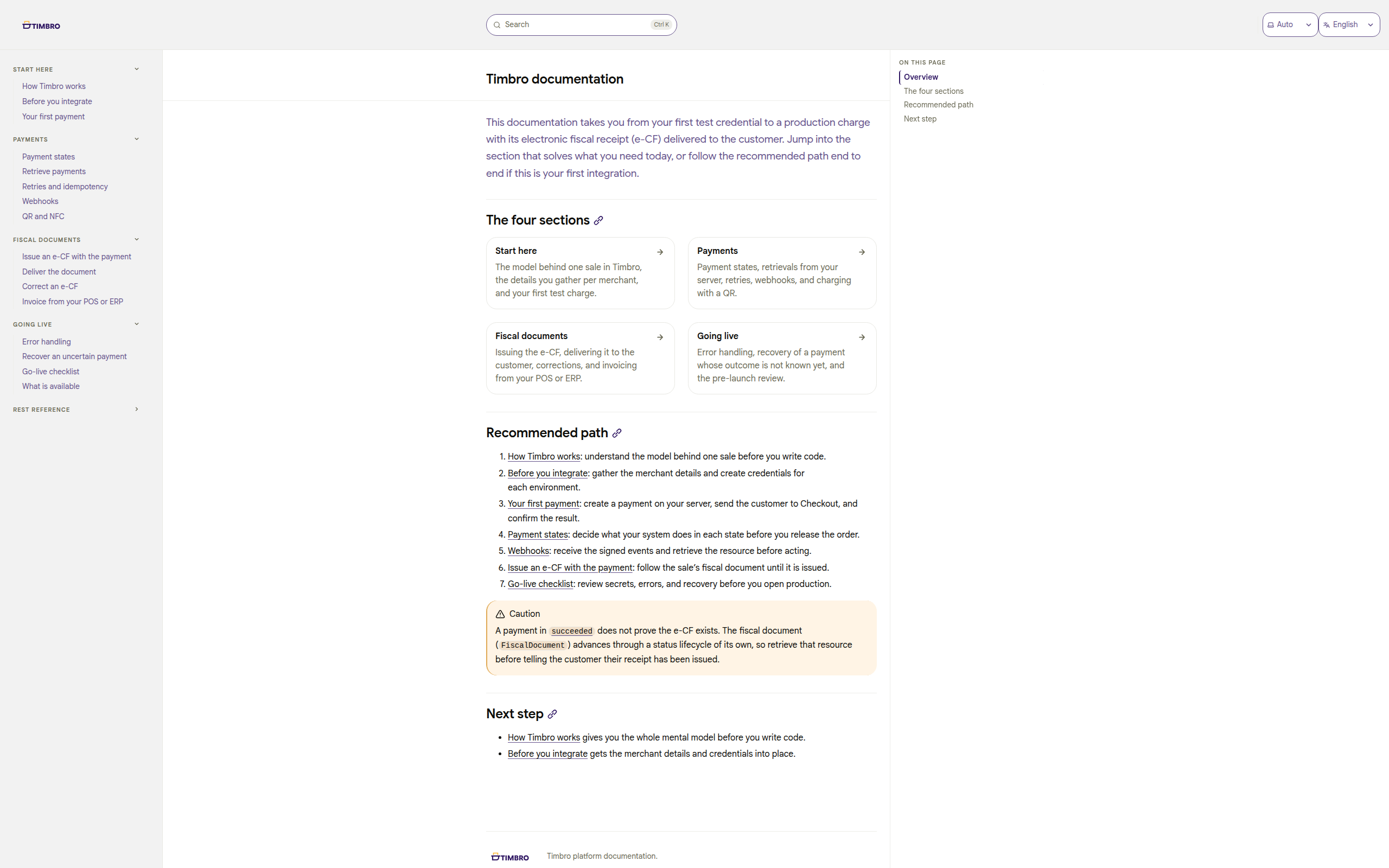
Public OpenAPI contract
Client ready to consume the API
Signed and deduplicated
Idempotency-Key on every write
Separate credentials for testing and production
Spanish and English, open online
06
Numbering
External assignment
It sends the e-NCF; Timbro validates its structure, type, uniqueness, and membership in the range before processing the operation
Central assignment
Takes a number from an authorized range in the same transaction that accepts the operation, with no intermediate steps
Distributed assignment
Each system receives a reserved range to operate without collisions across locations
Scope by RNC, e-CF type, and environment
Expiry and remaining capacity visible
Assignment confirmed in one transaction
Timbro records DGII authorizations and assigns sequences within authorized ranges
Two operations never share a number, whichever model you choose
07
Signing and custody
Signing in your environment
Timbro signs from the infrastructure agreed for your operation, with access and responsibilities defined in the proposal
The implementation protects the certificate and limits its use to authorized signing operations
Works with certificates accepted for your tax operations
Each business, location, and environment keeps its own configuration
Only authorized staff manage signing
Each signature is associated with the corresponding certificate
08
Operations and locations
Distributed fiscal identity
Five distinct levels, so no location shares certificates or sequences indiscriminately
The Local proposal defines where each function operates and the responsibilities of Timbro and the business
Timbro Local
The implementation places signing and the agreed components in the environment named by the business
Scope by location the proposal identifies the functions included in each implementation
Agreed service any support, continuity, or recovery commitment applies only when stated in the signed order
09
Lifecycle
The request is accepted once, even if repeated
Each stage has an explicit status
Retries and uncertain results are resolved through retrieval and reconciliation
Recovery returns the document; it never issues another
An uncertain result is clarified by retrieving status, never by issuing again
Evidence per operation
10
Delivery and retention
Delivery
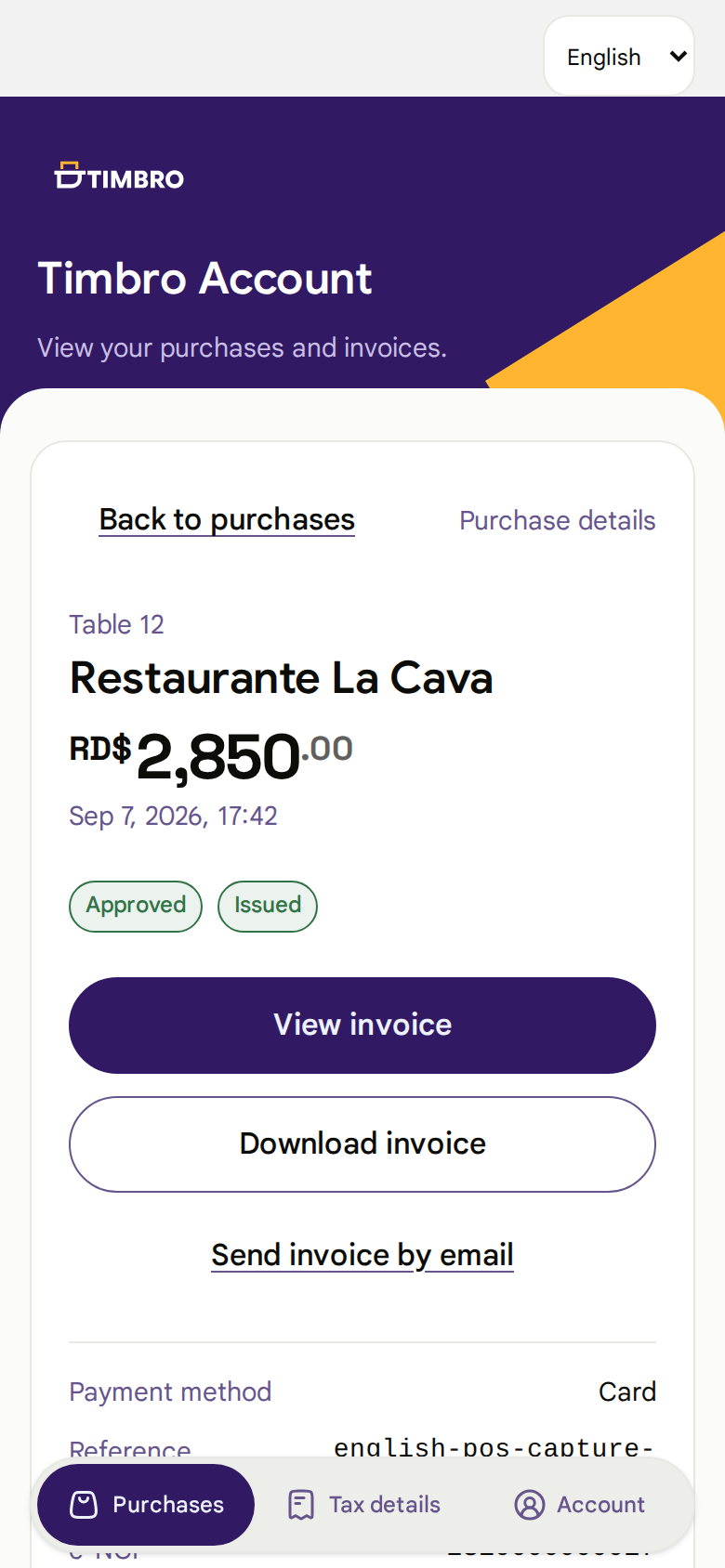
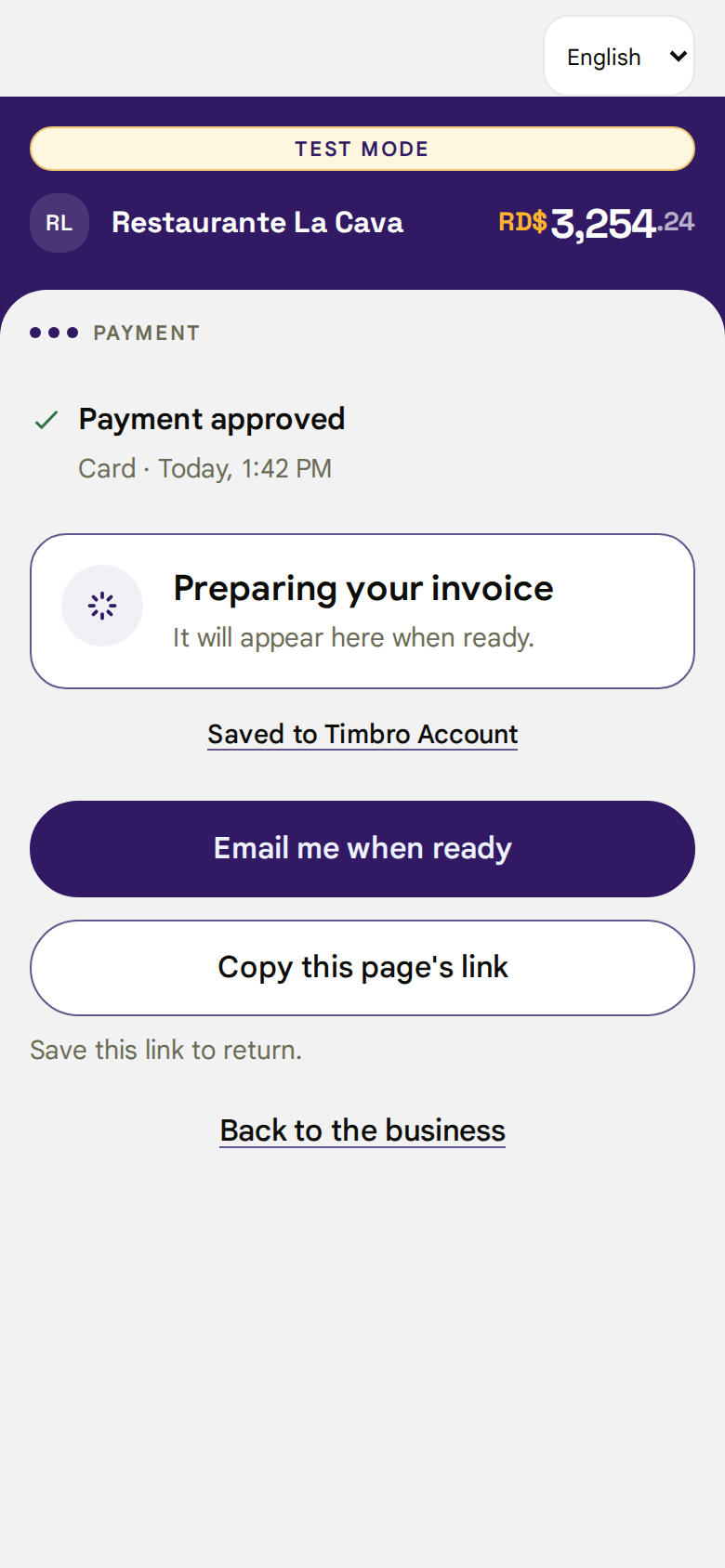
Email with delivery statuses, XML and printed representation downloads, and a Timbro account where the recipient can find invoices
Retention
We retain your invoices and their evidence for 10 years, so the business does not manage storage
An issued document is not edited: the accounting correction is a credit note
11
Responsibilities
Invoices and their evidence remain available without managing storage
Numbering runs where it suits the business, with the same controls
Timbro keeps up with DGII changes to format and communication
Each response explains what happened and what your team should do
Email, document download, and a Timbro account for the invoice recipient
Every operation can be reconstructed and none is issued twice
12
How we start
Test credentials and documentation
Business certificate and ranges
Integration and testing
DGII certification
Production
13
Plans
For RST businesses and SMEs getting started
RD$0per RNC, per month
500 invoices a month
For businesses with more invoices each month
RD$1,790per RNC, per month, plus ITBIS
10,000 invoices a month
For large companies and high volume
FromRD$9,990per RNC, per month, plus ITBIS
100,000 invoices a month
2027 rates in Dominican pesos per RNC, plus ITBIS. Service terms
All plans free for the remainder of 2026. Conditions apply
14
Enterprise plan
Timbro installed in your infrastructure, with signing in your environment
Multiple RNCs, locations, and custom integrations
Reserved capacity and support defined by contract
15
Next step
An integration with the ERP, POS, or custom system, with numbering, signing, delivery, and evidence handled by Timbro
Timbro objective
Every business reaches November 1, 2026 issuing e-CF, with its certified profile and its evidence in ordertimbro.do
16